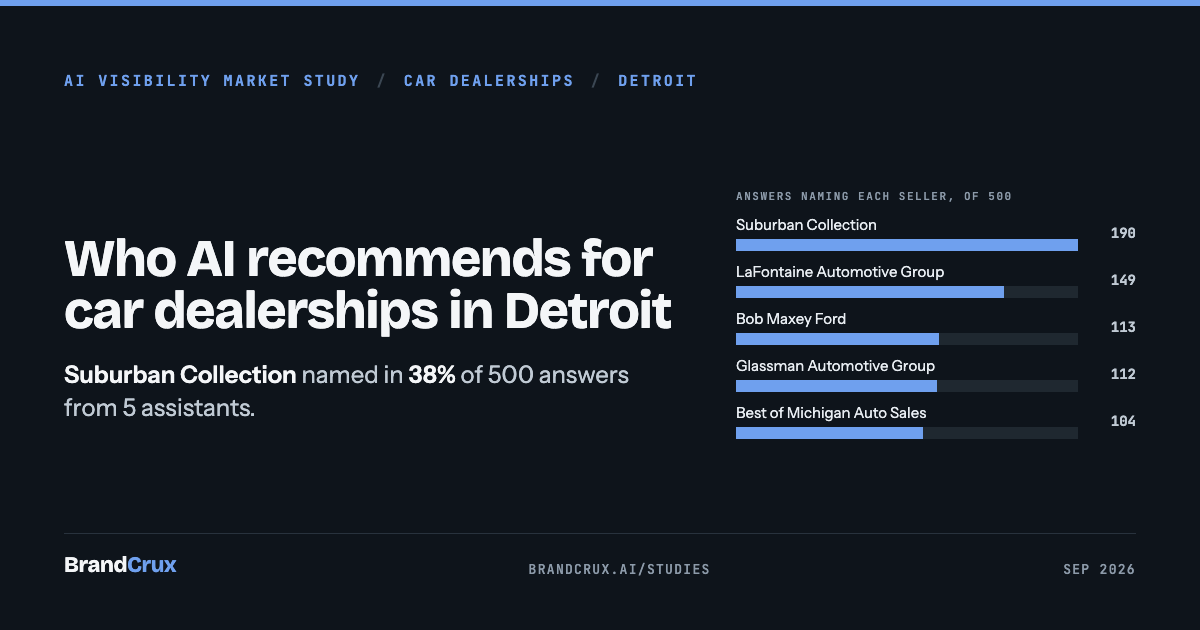
A market study asks one question of one place: when a buyer there asks an AI assistant for help choosing, which businesses come back? It anchors on no brand: every business an assistant names is a participant, and every answer is read to count them. This is the first one we ran, on car dealerships in metro Detroit. The full study carries every question and every answer.
What we asked
Fifty questions across eight topics a buyer moves through: buying new, buying used, service and repair, finance and leasing, trade in, electric and hybrid, trucks and work vehicles, and trust. None of them names a dealership. Two examples: best Chevrolet or GMC dealer near Detroit and which Detroit dealerships give the best trade in value.
ChatGPT, Gemini, Copilot and Google AI Overviews answered each question as a buyer would see them on the web, from a US connection. Claude answered through its API with no live search, so what it says comes from what its model learned. We ran the set twice on 18 Sep 2026, 500 answers in all, and a judge model listed every business each answer named and whether it linked to that business's website.
One group is the default answer
Suburban Collection was named in 190 of the 500 answers, 38 percent. Four more groups were named in more than one answer in five.
| Seller | Named | Share | Linked |
|---|---|---|---|
| Suburban Collection | 190 | 38% | 83 |
| LaFontaine Automotive Group | 149 | 30% | 13 |
| Bob Maxey Ford | 113 | 23% | 50 |
| Glassman Automotive Group | 112 | 22% | 27 |
| Best of Michigan Auto Sales | 104 | 21% | 59 |
| Szott Auto Group | 86 | 17% | 1 |
| CarMax | 82 | 16% | 47 |
| Bill Brown Ford | 79 | 16% | 50 |
Linked counts answers that pointed to any of the seller's own websites. suburbancollection.com alone was linked in 76 answers, the most of any site, with autotrader.com next at 31. Claude's links are recalled by the model rather than retrieved from a search.
Memory answers and web answers are different markets
Claude answered from what its model learned, while the other four assistants searched the web first. Splitting the leaderboard by that difference separates the sellers the model remembers from the ones the web recommends.
| Seller | Claude, of 100 | Web assistants, of 400 |
|---|---|---|
| Glassman Automotive Group | 98 | 14 |
| Szott Auto Group | 79 | 7 |
| Bowman Auto Group | 55 | 7 |
| Suburban Collection | 98 | 92 |
| Bob Maxey Ford | 7 | 106 |
| Best of Michigan Auto Sales | 0 | 104 |
| Jefferson Chevrolet | 0 | 65 |
The first three rows are names the model knows, yet the pages the web assistants read in September seldom put them forward. The last three run the other way: the model has barely learned them, while the live web recommends them often. Suburban Collection is the only group strong on both sides.
The two gaps call for different work. When the model knows a name and the web does not repeat it, the pages that answer buyer questions today do not mention the group. When the web recommends a name the model has not learned, the dealer has less control. Assumption: that gap closes only when the model is retrained on newer pages, so it moves on the model maker's schedule rather than the dealer's.
Each assistant keeps its own shortlist
Copilot sent Detroit buyers to independent used car lots: Best of Michigan Auto Sales in 52 of its 100 answers, Car Source in 40, Empire Auto Sales in 36 and CarDome Auto Sales in 31. It named Suburban Collection in 5. Google AI Overviews put Suburban first, in 36 of 100 answers, while ChatGPT and Gemini both led with Bob Maxey Ford, at 30 and 35.
Topics show where the openings are
Suburban Collection leads five of the eight topics: new cars, service and repair, finance and leasing, electric and hybrid, and trucks. The other three are contested.
- Trade in belongs to national retailers. CarMax was named in 39 of 60 trade in answers and Carvana in 37. The first local dealer, Suburban, was named in 22.
- Used cars is a three way tie. Best of Michigan Auto Sales was named in 26 of 70 answers, Suburban in 25, CarDome in 24.
- Trust and experience is led by LaFontaine, named in 34 of 70 answers, and none of those 34 answers linked to a LaFontaine site.
Who takes the answer instead
Only 15 of the 500 answers named no dealership. The assistants still sent buyers elsewhere alongside the dealers: Ford was named in 100 answers as a make, Cars.com in 60, Edmunds in 52, CARFAX in 51 and Autotrader in 42. Service questions produced the most answers with no dealer in them; 5 of the 10 answers to where to get warranty repairs done in the Detroit area named none.
Sales and visibility rank differently
We read the answers against inferred sales: vehicles that left each dealer website between May and July 2026, counted per website across all makes, new and used. They record listings leaving the site; the sale itself is inferred. The pull covers the 25 largest sellers in each of 69 metro cities.
| Rooftop | Sold | Named | Group named |
|---|---|---|---|
| Bill Brown Ford | 1,971 | 79 | |
| Serra Chevrolet Sterling Heights | 1,829 | 8 | Serra Automotive, 35 |
| Moran Chevrolet | 1,658 | 7 | Moran Automotive, 13 |
| Feldman Chevrolet of Novi | 1,417 | 5 | Feldman Automotive, 79 |
| LaFontaine Chevrolet Plymouth | 1,364 | 0 | LaFontaine Automotive Group, 149 |
| Pat Milliken Ford | 1,275 | 71 |
Bill Brown Ford and Serra Chevrolet Sterling Heights sold within 150 vehicles of each other. The assistants named Bill Brown in 79 answers and the Serra store in 8. Where a group has a strong name, the assistants name the group and the store drops out: LaFontaine was named 149 times, and its Plymouth Chevrolet store, the group's largest seller in this data at 1,364 vehicles, not once.
The largest seller in the pull was Driveway, the online store of Lithia & Driveway, at 6,616 vehicles. Lithia bought The Suburban Collection in 2021 (Lithia Motors & Driveway press release, April 2021), so those sales sit beside the most named group in the study. Driveway itself was named twice.
What this does not establish
- One day, two runs, 50 questions. A single answer can turn on chance; the pattern across 500 is the finding.
- The questions anchor on Detroit and were asked from a US connection rather than from inside the city, so suburbs with their own trade areas are understated.
- Naming measures who is considered; visits and sales would need their own data.
- The judge can miss or misread a name. We merge names on a normalised form and roll stores into groups from a seed list, which can misplace a store with a similar name.
- Sales are inferred from dealer website listings and cover only the largest sellers in each city; a different window would move them.
- A repeat run in another week, or the same questions asked from a connection inside Detroit, would show whether this order holds.
Every question, the sellers named on it and the raw answer from each assistant and run are on the Detroit study page. A second study, on car dealerships in Greater Manchester, uses the same method.
Anand Mahajan, founder of BrandCrux